
Ten hospitals, $2.8 billion, zero private equity: who bought the Community Health Systems divestiture book
Community Health Systems closed 10 hospital divestitures between January 2023 and June 2026, totaling $2.80 billion in disclosed proceeds. Every named buyer is a nonprofit. Vanderbilt, Duke, Tampa General, Huntsville Hospital, Ascension, AdventHealth, Hamilton Health Care, Freeman Health, and Vandalia Health each picked up a former CHS market in an adjacent service area. Two announced deals (Novant for Lake Norman, WoodBridge for Commonwealth Health) terminated before closing. The narrative that private equity rolls up the distressed for-profit hospital divestiture book does not hold for this cycle.
$2.80B
Closed proceeds, 10 hospital deals
100%
Nonprofit buyers
60
Hospitals CHS still operates
This post is about who actually bought the hospitals Community Health Systems sold between January 2023 and June 2026, what they paid, and what is left. Every chart below was generated live in Claude with the Medistill MCP connector loaded. The prompts we typed are shown inline so you can rerun them yourself against any other public hospital operator.
The data is the SEC EDGAR 8-K M&A index for the deal side, SEC XBRL company-facts for CYH financials, and CMS HCRIS for the remaining-footprint cost-report numbers. Every deal in the table below links to the source 8-K. Every financial number is keyed to a public XBRL fact.
The framing matters because the consensus take on publicly-traded for-profit hospital chains shedding assets has been that private equity is the buyer of last resort for the markets they exit. That framing is correct for some operators in some years. It is wrong for CHS over the past three years.
Why CHS is selling
CHS carried roughly $13.4 billion of long-term debt at fiscal year-end 2019. By fiscal year-end 2025, that number was $10.4 billion. The $3 billion of debt paydown was explicitly funded by the divestiture program. Management has said as much on every quarterly call going back to 2022. The interesting question is not why CHS is selling. It is which hospitals can clear at a price that funds the paydown, and who is on the other side.
Worth holding in mind throughout the rest of this post: every transaction below is also a community of patients and a workforce of clinicians and staff moving from one operator to another. The deleveraging math is real. So is the disruption that lives behind each closing-date 8-K.
The pricing answer turns out to be: a lot of them. Median disclosed price across the 10 hospital deals is $272 million. The largest single transaction in the cycle, Tennova Clarksville to Vanderbilt at $623 million, closed in February 2026. The smallest, Greenbrier Valley Medical Center to Vandalia Health at $85 million, closed January 2023. Most of the deals landed in the $150 to $460 million band.
The deal table
First chart is the bird's-eye view: every completed CHS hospital divestiture since January 2023, plotted by close date and disclosed price, color-coded by the kind of nonprofit on the buy side.
Prompt to Claude (Medistill MCP loaded):
> Chart every CHS hospital divestiture since 2023. Time on x-axis, price on y-axis, color by buyer type.
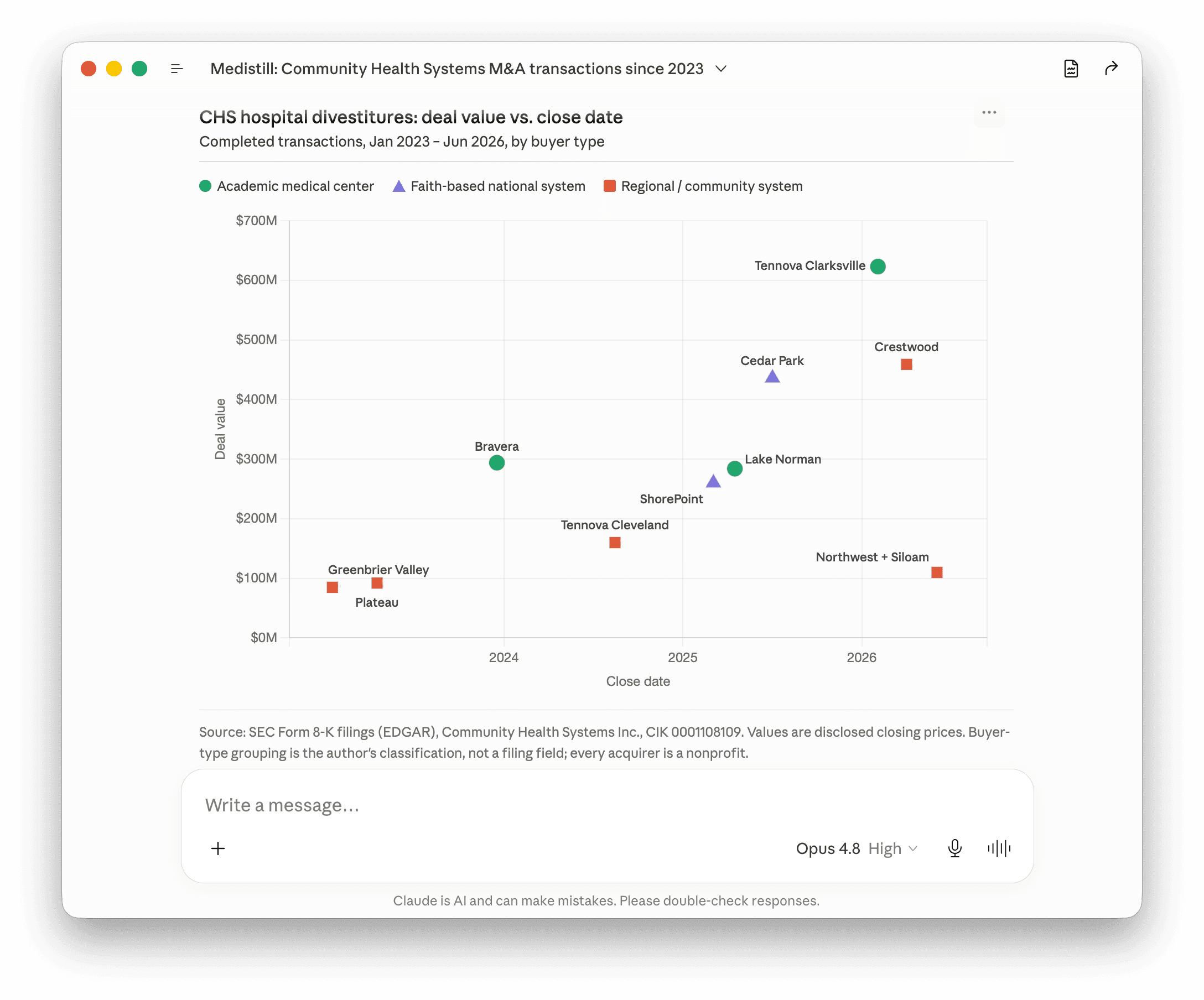
Two patterns jump out. First, the disclosed prices trend upward as the cycle progresses: the 2023 cluster sits near $85-294M, while 2025-2026 deals span $110-623M, including the cycle's single largest transaction (Vanderbilt paying $623M for Tennova Clarksville, closed February 2026). Second, there is no fourth color on this chart. Every dot is one of the three nonprofit categories. Deal-by-deal detail, with each row linking to the source 8-K:
Closed CHS hospital divestitures, January 2023 to June 2026
Northwest Bentonville + Springdale + Willow Creek Women's + Siloam Springs (4 hospitals, 487 beds)
2026-06-01·AR·Freeman Health System·Leerink Partners advised CHS
$110M
8-K
Crestwood Medical Center
2026-04-01·AL·Huntsville Hospital Health System·Leerink Partners advised CHS
$459M
8-K
Tennova Healthcare - Clarksville
2026-02-01·TN·Vanderbilt University Medical Center·Leerink Partners advised CHS
$623M
8-K
Cedar Park Regional Medical Center (CHS 80% JV stake)
2025-06-30·TX·Ascension
$436M
8-K
Lake Norman Regional Medical Center
2025-04-01·NC·Duke University Health System
$284M
8-K
ShorePoint Health Port Charlotte + Punta Gorda
2025-03-01·FL·AdventHealth
$260M
8-K
Tennova Healthcare - Cleveland
2024-08-01·TN·Hamilton Health Care System
$160M
8-K
Bravera Health (Brooksville, Seven Rivers, Spring Hill, 3 hospitals)
2023-12-01·FL·Tampa General (Florida Health Sciences Center)
$294M
8-K
Plateau Medical Center
2023-04-01·WV·Vandalia Health
$92M
8-K
Greenbrier Valley Medical Center
2023-01-01·WV·Vandalia Health
$85M
8-K
Source: SEC EDGAR 8-K filings by Community Health Systems, Inc. (CIK 0001108109). Each row links to the closing 8-K on sec.gov. Where both an announcement and a closing 8-K exist, the closing price is shown.
Sum of disclosed closing prices across the ten hospital deals: $2.80 billion. A separate non-hospital divestiture (CHS's ambulatory outreach laboratory services across 13 states) closed December 2025 for $195 million, sold to Labcorp. We exclude that from the hospital deal table because the buyer is a for-profit and the asset isn't a hospital; including it would push the cycle total to roughly $3.0 billion.
Announced but not closed
Two material divestitures CHS announced in this window never closed as filed. Both are worth surfacing because they explain plot twists in the main table, and because "deal terminated" does not always mean "status quo preserved" for the community on the receiving end.
Announced Feb 2023
Lake Norman Regional Medical Center + Davis Regional
Buyer: Novant Health (~$320M)
Terminated 2024 after FTC challenge. Lake Norman subsequently sold to Duke for $284M (in main table).
Announced Jul 2024
Commonwealth Health System (PA, 3 facilities)
Buyer: WoodBridge Healthcare (~$120M)
Terminated Nov 2024 per CHS's filing. The trade press reported financing as the cause; that has not been independently confirmed in the 8-K body.
The Novant termination is the more instructive of the two: the deal cleared the boards but lost at the FTC. Lake Norman ultimately re-cleared the same boards with Duke as buyer ($284M for the single hospital, vs the original $320M for Lake Norman plus Davis Regional as a package). Davis Regional was not part of the Duke transaction. The lesson for diligence teams: 8-K filings do not equal closed transactions, and a repriced deal often has a different scope than the original.
Who actually bought
Same data, different question: how does the $2.80 billion in closed proceeds split across buyer type?
Prompt to Claude (Medistill MCP loaded):
> Donut chart of CHS divestiture proceeds since 2023, split by academic / regional nonprofit / other.
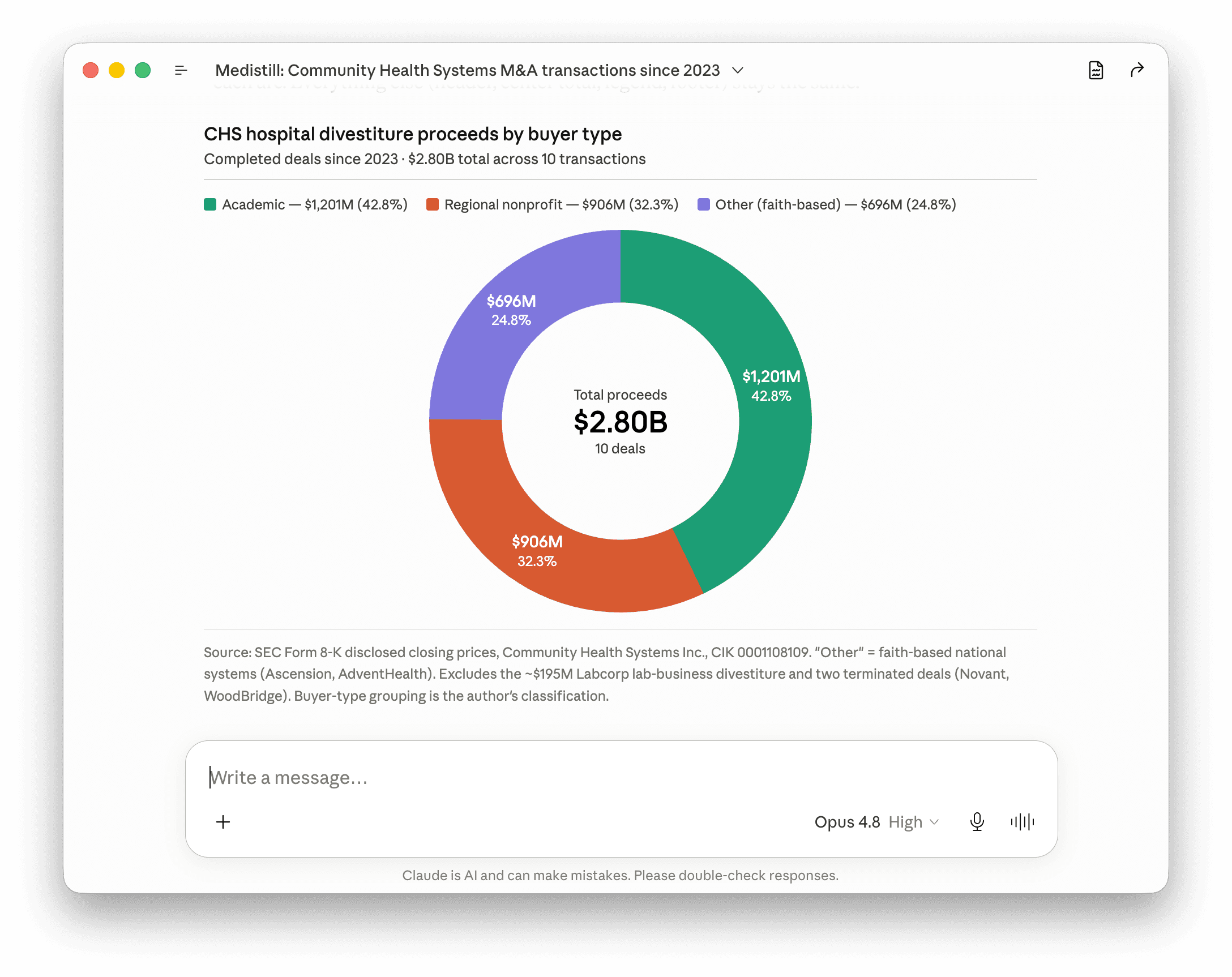
Academic: $1.20B (43%)
- Vanderbilt UMC, $623M (Tennova Clarksville)
- Tampa General, $294M (Bravera Health)
- Duke University Health, $284M (Lake Norman)
Regional/community: $906M (32%)
- Huntsville Hospital, $459M (Crestwood)
- Hamilton Health Care, $160M (Tennova Cleveland)
- Freeman Health, $110M (4 Arkansas hospitals)
- Vandalia Health, $92M (Plateau)
- Vandalia Health, $85M (Greenbrier Valley)
Faith-based national: $696M (25%)
- Ascension, $436M (Cedar Park)
- AdventHealth, $260M (ShorePoint)
Zero private-equity buyers. Zero for-profit hospital operators. The only for-profit transaction in the cycle is the Labcorp lab carveout, which is a different asset class entirely.
The pattern that matters for diligence teams: the buyers are adjacent. Vanderbilt sits 50 miles from Tennova Clarksville. Huntsville Hospital is in the same metro as Crestwood Medical Center. Duke and Lake Norman both serve the Charlotte metro. Tampa General and Bravera Health overlap directly on the Tampa-Brooksville corridor. Freeman Health is the dominant operator in Southwest Missouri and Northwest Arkansas. Every nonprofit buyer bought into a service area they already operate. Pricing cleared because the synergy case writes itself.
Topline and debt
Zooming out to the issuer level: the divestiture program reads as deleveraging, not wind-down. Same-store revenue at the retained hospitals is holding the topline roughly flat even as the chain has shed assets.
Prompt to Claude (Medistill MCP loaded):
> Chart CYH revenue, long-term debt, and stockholders' equity for FY2019 through FY2025.
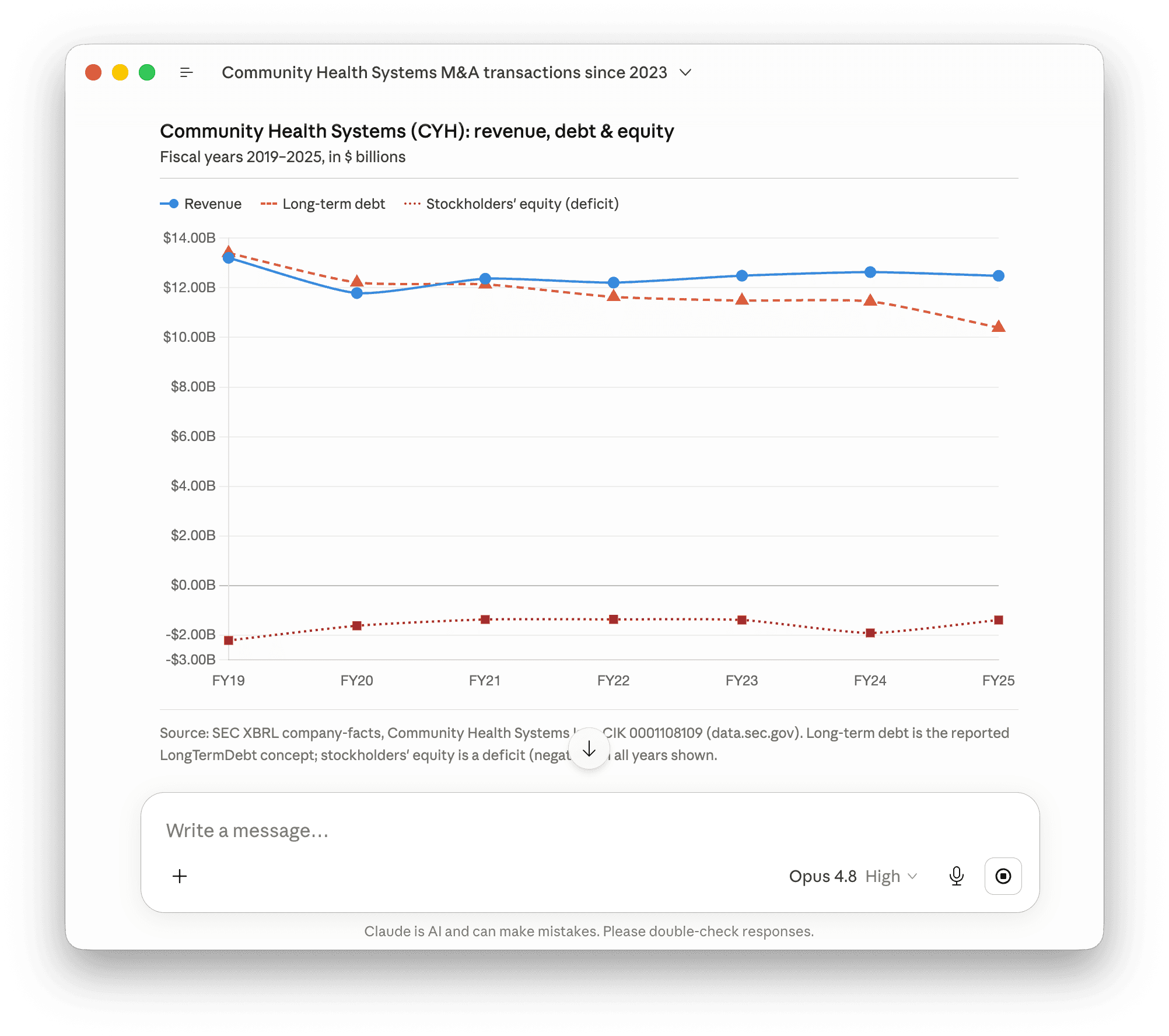
CYH audited financials, FY2019 to FY2025
| FY | Revenue | Op margin | Net income | LT debt | Equity |
|---|---|---|---|---|---|
| FY2019 | $13.21B | 4.9% | -$675M | $13.41B | -$2.22B |
| FY2020 | $11.79B | 9.6% | +$511M | $12.22B | -$1.63B |
| FY2021 | $12.37B | 11.3% | +$230M | $12.14B | -$1.37B |
| FY2022 | $12.21B | 6.7% | +$46M | $11.64B | -$1.37B |
| FY2023 | $12.49B | 7.7% | -$133M | $11.49B | -$1.39B |
| FY2024 | $12.63B | 4.3% | -$516M | $11.45B | -$1.91B |
| FY2025 | $12.49B | 11.9% | +$509M | $10.40B | -$1.39B |
Source: SEC XBRL company-facts API for CIK 0001108109. Long-term debt and equity are balance-sheet, year-end.
Three things to notice. First, revenue has held roughly flat near $12.5 billion since 2020 even as the asset base shrank from $15.6 billion (FY2019) to $13.2 billion (FY2025). Second, long-term debt is down $3.0 billion over the period, a 22 percent reduction. Third, stockholders' equity has been negative every year going back to at least 2019, sitting at -$1.39 billion at fiscal year-end 2025.
The FY2025 net income spike to +$509 million is largely gain-on-sale from the year's closed divestitures, not operating recovery. Operating margin in FY2025 came in at 11.9 percent, the best year in the period, but the underlying same-store operating posture in the retained book has been in the 4 to 8 percent operating-margin band in most quarters.
The $600 million kicker
On April 22, 2026, three weeks after closing the Crestwood-to-Huntsville Hospital sale and two months after closing Tennova Clarksville to Vanderbilt, CHS launched a cash tender offer for up to $600 million of two specific secured notes: the 4.750 percent senior secured notes due 2031 and the 10.875 percent senior secured notes due 2032. The May 6, 2026 early-tender results 8-K reported $994 million of the 2031 notes (94 percent of the issue) and $822 million of the 2032 notes (46 percent of the issue) were validly tendered.
Demand exceeded supply on both tranches. After proration, roughly $600 million of secured debt actually retires. The 10.875 percent coupon on the 2032s is the most expensive money on the CHS balance sheet. That tender is the through-line: divestiture proceeds in, highest-coupon secured debt out, all in the same quarter the deals close.
For analysts modeling CYH forward interest expense, the tender mechanics matter more than the headline divestiture proceeds. Retiring $600 million at a 10.875 percent weighted coupon takes $65 million of annual interest expense out of the run-rate. That is the deleveraging payoff that has not yet shown up in the consensus EPS deck.
What's left
The June 1, 2026 8-K accompanying the Arkansas closing states CHS's post-Arkansas footprint at 60 affiliated hospitals with more than 8,000 beds, operating more than 800 sites of care in 32 distinct markets across 12 states. That is the authoritative number as of June 1, 2026.
Our hospital screener (CMS HCRIS plus the CMS provider ownership overlay) has confirmed CCNs on 11 of those 60 hospitals as of FY2024, totaling 1,559 beds and $1.58 billion in net patient revenue. The 11 cluster in three states (AL, MS, TX). The Mississippi cluster, seven facilities trading under the Merit Health brand, is the obvious next package deal: small enough that a single regional nonprofit could absorb the block, large enough that the Merit Health brand goodwill has real value, and geographically contiguous enough to clear antitrust review.
The standout in the confirmed eleven is Laredo Medical Center in Texas. FY2024 net patient revenue of $373 million on 289 beds, with a 33 percent operating margin. For context, the median FY2024 operating margin across the entire HCRIS acute-care universe was roughly 2 to 4 percent. Laredo is materially over-earning. If CHS continues divesting through 2027, Laredo and the larger Texas asset (Longview Regional, $328 million FY2024 revenue on 224 beds, 9.2 percent operating margin) are the obvious premium-price candidates.
The bottom of the same eleven looks different. Grove Hill Memorial in Alabama posted a -53.7 percent operating margin in FY2024, with discharges down 63 percent year-over-year. On the financial comp set, that is not a marketable asset.
It is also one of the few hospitals serving Clarke County, AL, a rural community of roughly 24,000 residents. The financial conclusion (closure candidate) sits next to a service-area question (what happens to emergency response time and obstetric access if Grove Hill closes) that the comp set does not answer. Both sides of that question are worth holding when modeling the back half of the divestiture cycle.
What it means
For private-equity hospital deal teams
The CHS divestiture book is not a PE feeder. Three full years of priced deals went entirely to academic systems, faith-based national operators, and regional nonprofits, each with adjacency rationale. The synergy case those buyers can write does not lose to a sponsor IRR target. If your screen assumes for-profit chain divestitures cycle into PE platforms, this corner of the market is not behaving that way.
For nonprofit M&A teams
Vanderbilt at $623 million for one hospital. Huntsville Hospital at $459 million. Ascension at $436 million. These are not distressed-sale clearing prices. The bid for a CHS asset in an adjacent service area is meaningfully higher than the same nonprofit would pay for an out-of-footprint target with the same financials. The signal: bid early on the next round, bid full on adjacency, and assume Leerink Partners will run the auction.
For distressed-asset and HY credit analysts
The $600 million tender in April 2026 retires the 10.875 percent 2032s and a chunk of the 4.750 percent 2031s. Forward interest expense drops by roughly $65 million annually. CYH equity is still book-negative at -$1.39 billion. The path to positive book equity runs through two more years of similar-magnitude divestitures plus the gain-on-sale flow-through. The Mississippi Merit Health package is the most-watchable next event.
None of the three workflows above is exotic. They are the standard PE diligence, nonprofit M&A, and HY credit workflows that have run for decades. The constraint was always assembling the per-deal table, the buyer classification, the topline and debt trajectory, and the forward-tender mechanics into one view. That used to take an analyst week. The version you just read took 30 minutes.
Closing
There is no scandal in this post. CHS disclosed each transaction in the proper 8-K, with the closing 8-K filed in the proper window, with the financial advisor listed where required. Every buyer named here is a real operator with a real strategic reason to bid. The divestiture program is doing exactly what management said it would do, at prices the market is willing to clear, to buyers the consensus narrative did not predict.
The reason this analysis is worth publishing is that the consensus narrative is still wrong. Trade-press coverage of CHS divestitures has framed buyer-after-buyer as individually surprising. Read together as a cohort, the pattern is unmistakable and structural. Regional nonprofits and academic systems are the bid for publicly-traded for-profit hospital exits in markets where the buyer already has an operating presence. They pay full prices. They use named bankers. They close on the disclosed schedule.
The next CHS quarterly call is in late July 2026. Management is likely to disclose the size of the next divestiture pipeline at that point. The same query rerun against the next cycle's filings will surface the next round of buyers within a week of the 8-Ks hitting EDGAR. The communities on the receiving end of those deals deserve the same attention as the deal multiples.
Run the analysis yourself
Every deal, financial number, and footprint figure in this post came from a Medistill MCP query you can rerun against any public hospital operator. Build the same divestiture history, buyer mix, and tender-offer cross-reference for HCA, Tenet, UHS, or any other named chain in a single conversation.
From $199/month. Cancel anytime. Full SEC EDGAR 8-K M&A index, SEC XBRL financials, CMS HCRIS cost reports, and hospital ownership overlays.