
Line 4a, $137 million: what 2024's largest disclosed ERISA deposit violations reveal
Schedule H Part IV Line 4a is the box on a Form 5500 where a plan sponsor self-discloses a failure to transmit participant contributions to the plan trust on time. It is the most-prosecutable disclosure in the entire ERISA filing universe. The 2024 cycle published billions of dollars in Line 4a amounts. The five largest disclosures by themselves total $448 million. The brokers, deal teams, and ERISA defense counsel they affect have mostly not noticed.
$137.6M
UH Health System single-plan flag
$1.37B
Top 5% of 2024 Line 4a disclosures
166
Schedule H columns now queryable
This post is about what the 2024 Form 5500 Schedule H Part IV disclosures say, who they affect, and why an entire class of buyers (benefits brokers prospecting self-funded employers, private-equity deal teams running pre-LOI diligence on a target's plan, ERISA fiduciary defense counsel taking on a new client) walks past these numbers every year. The work was done in Claude Desktop with Medistill loaded as a research backend. Every query is reproducible. The actual prompts are pasted inline so you can run them yourself. The data is public on the DOL EFAST2 system. The receipts have been there the whole time.
The framing matters. Schedule H Line 4a is not a discretionary disclosure. The sponsor either failed to deposit withheld contributions to the trust within the DOL safe harbor window (seven business days for plans with under 100 participants, as soon as administratively feasible and no later than the fifteenth business day of the month following the withholding for larger plans) or they did. The box gets checked yes or no. If yes, the dollar amount is required. The amount stays on the filing until the prohibited transaction is corrected through the DOL Voluntary Fiduciary Correction Program (VFCP), at which point a future filing can show the amount drop to zero. Until that happens, the disclosure reprints on every annual filing.
The cumulative reprint behavior is itself the story. The largest 2024 disclosures show 2023 and 2024 amounts that match to the dollar. That is the disclosure pattern of a sponsor who knows about the problem, is working through the correction, and has not yet closed it out. It is also the most actionable insight a benefits broker can walk into an employer meeting with.
What Line 4a is
Schedule H Part IV is the compliance disclosure section of the large-plan financial statement (100+ participants). It contains a series of yes-or-no flags that each carry a dollar field if the answer is yes. The flags include failure to transmit contributions (Line 4a), failure to pay benefits when due (Line 4b), loans in default (Line 4c), leases in default (Line 4d), non-exempt party-in-interest transactions (Line 4e), losses discovered during the plan year (Line 4f), assets at undetermined value, non-cash contributions, fidelity bond inadequacy, and several others. Line 4a is the most consequential because it is functionally a sponsor saying, in writing, that participant money was held longer than ERISA allows.
DOL EBSA enforcement priorities lean directly on Line 4a. The agency's Form 5500 Investigation Process Guide tells investigators to pull every filing where Line 4a is checked yes, walk the dollar amount against the deposit-correction schedule, calculate lost earnings, and assess a Section 502(l) civil penalty if not corrected through the Voluntary Fiduciary Correction Program (VFCP). The Line 4a dollar amount is essentially a self-assessed exposure number.
All of this has been true for two decades. What is new is that the entire Schedule H Part IV surface is now queryable. Medistill ingests every Part IV field for every large-plan filing from 2009 forward (1.5 million plan-year filings, 166 columns per filing). Before this week, the same cohort question required a benefits consultant to pull individual Form 5500 PDFs from EFAST2 and read them by hand.
The 2024 receipts
The first question to ask any dataset is the boring one that tells you whether the cohort exists at the scale you expect.
Prompt 1:
> Top 10 sponsors with the largest late-deposit disclosures on their 2024 Form 5500.
The deduped 2024 top five, by Line 4a amount on the largest plan filed by each sponsor:
Top five 2024 Schedule H Line 4a disclosures
University Hospitals Health System
OH
$137,609,142
Sysco Corporation
TX
$88,442,248
CEVA Logistics U.S. Holdings
Multi
$79,959,556
Global Medical Response, Inc.
Multi
$74,121,513
Moody's Corporation
NY
$68,623,989
Source: DOL Form 5500 Schedule H Part IV, plan year 2024 large-plan filings. Amounts shown are the maximum disclosed Line 4a amount across the sponsor's plan portfolio.
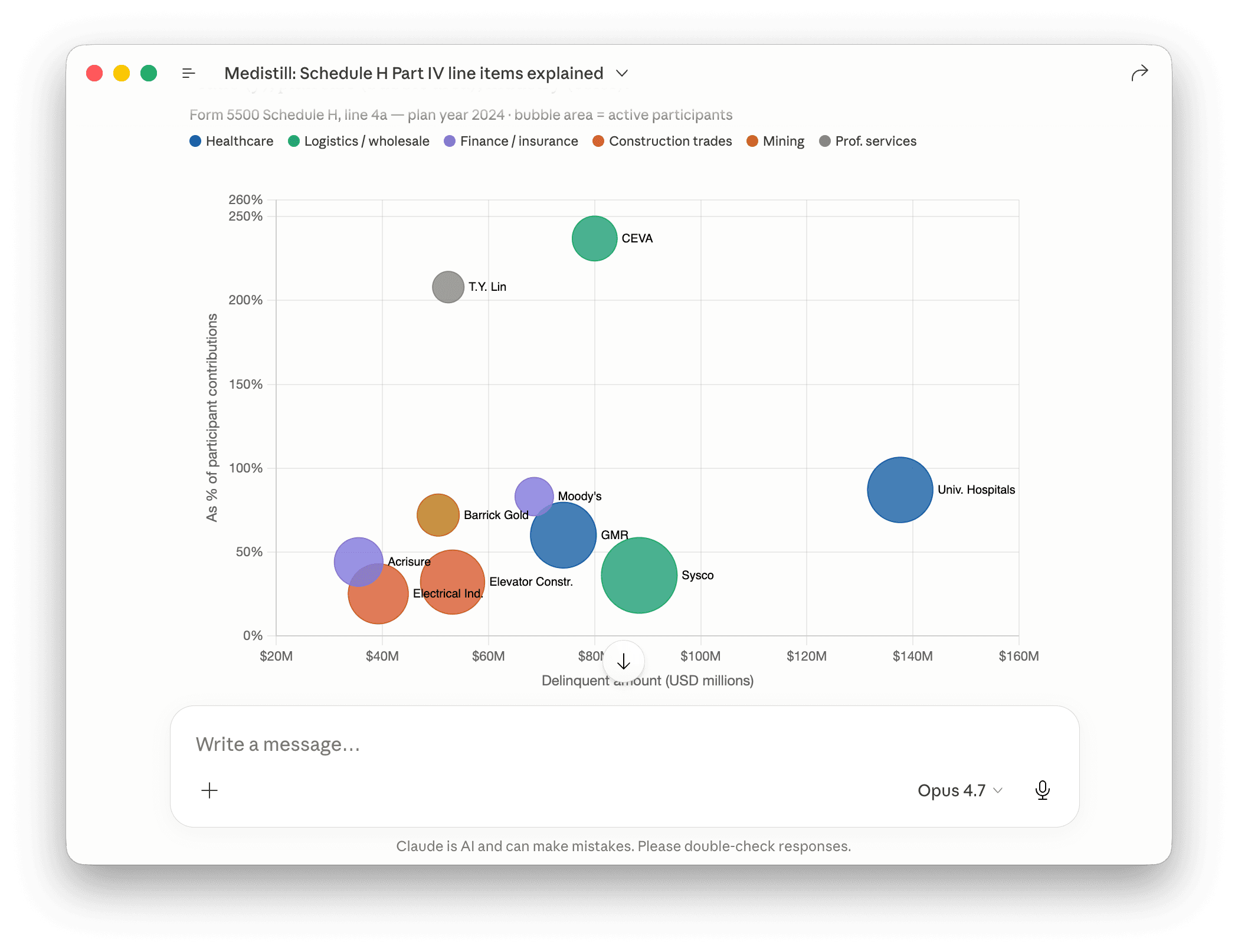
None of these are obscure organizations. UH Health System is a $5B+ revenue Cleveland-area integrated delivery network. Sysco is the largest food-service distributor in the United States. CEVA Logistics is one of the world's largest third-party logistics operators, owned by CMA CGM. Global Medical Response is the KKR-controlled emergency-services and air-medical roll-up that consolidated AMR, Air Evac Lifeteam, REACH, and several other regional providers. Moody's is the credit rating agency.
For each of these sponsors, the Line 4a disclosure means a fiduciary breach was self-reported. The dollar amount is the principal at issue, not the lost-earnings calculation or the Section 502(l) penalty assessment. The actual cost of full VFCP correction adds principal, lost earnings, IRS Form 5330 excise tax (15 percent of the prohibited transaction amount per year until corrected), plus the cost of legal and actuarial fees to structure the correction filing.
A $137 million disclosed Line 4a, fully corrected through VFCP, can produce a final cost to the plan sponsor in the $150 to $170 million range once lost earnings, multiple years of Form 5330 excise tax, and professional fees are layered on. None of that economic impact is otherwise visible to a benefits broker pitching the sponsor on a renewal, a PE diligence team modeling a target, or an ERISA defense counsel asked to represent the plan.
Three lenses, three different rankings
The raw-dollar ranking above is the headline view. It is not the most diligence-relevant view. Line 4a is a self-reported amount that can include accumulated prior-period delinquencies, lost-earnings cure dollars, and aggregate VFCP correction figures. The single disclosed number gets richer when you rotate it against two other denominators that already live on the same Schedule H filing.
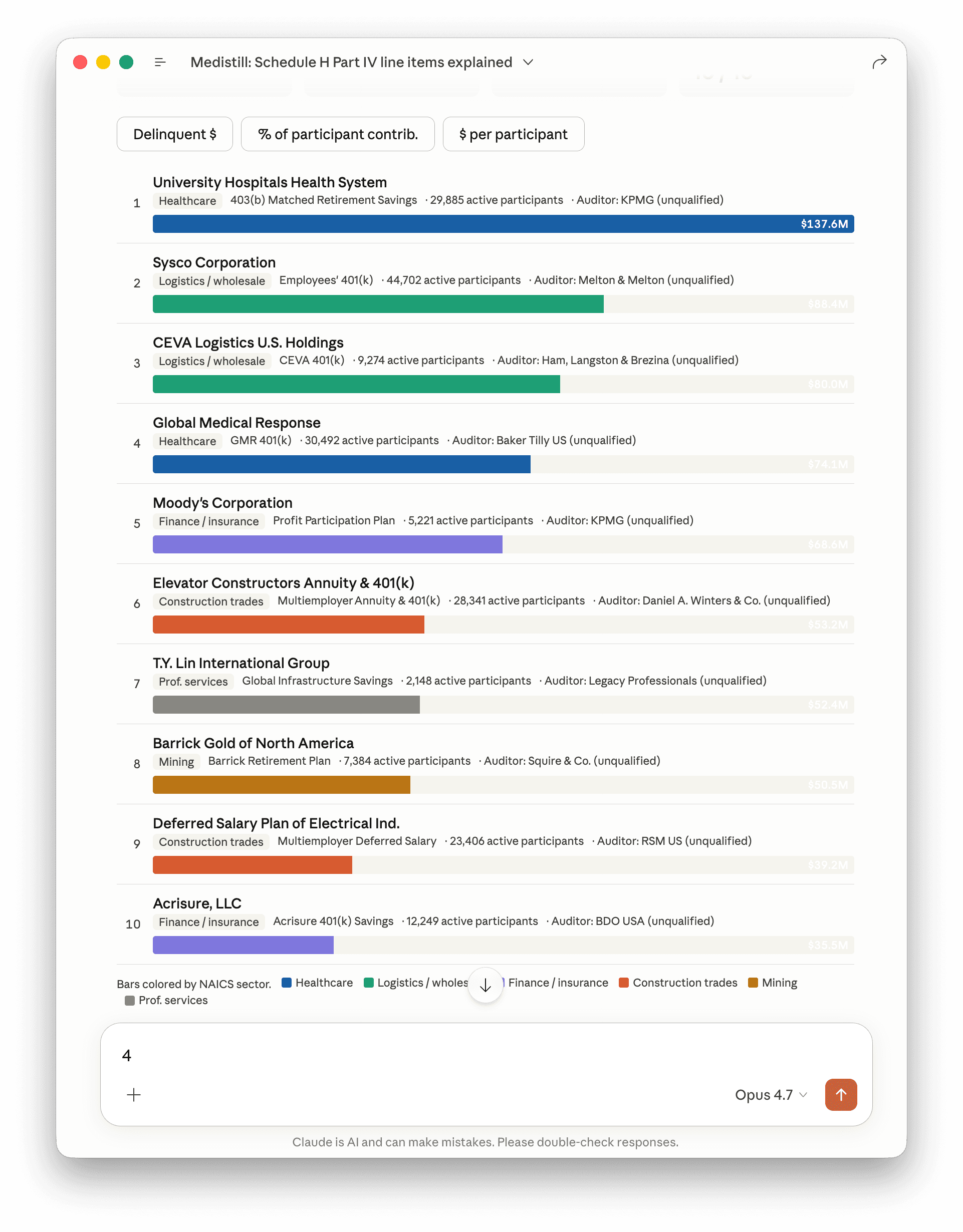
The first rotation is the ratio of Line 4a dollars to participant contributions income on the same plan year. Participant contributions income is the dollars participants actually contributed in 2024. If Line 4a is >100 percent of that, the disclosure cannot be a single year of late deposits. It has to include accumulated principal from earlier years that the correction has not yet closed out.
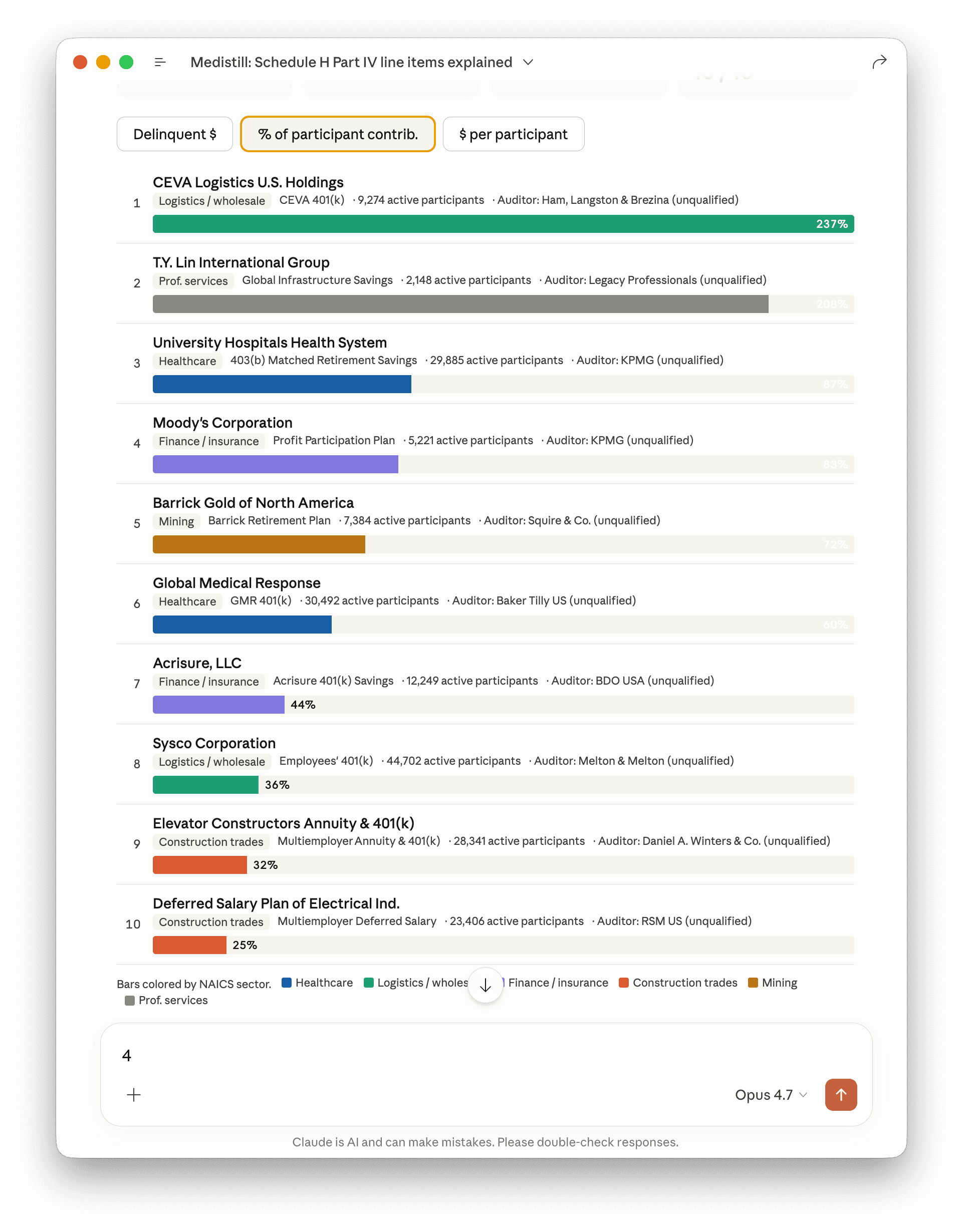
The second rotation is per-participant exposure. Sysco has the second-largest raw dollar flag but covers 44,702 participants. T.Y. Lin has the seventh-largest raw flag but covers only 2,148 participants. The per-head economics are very different.
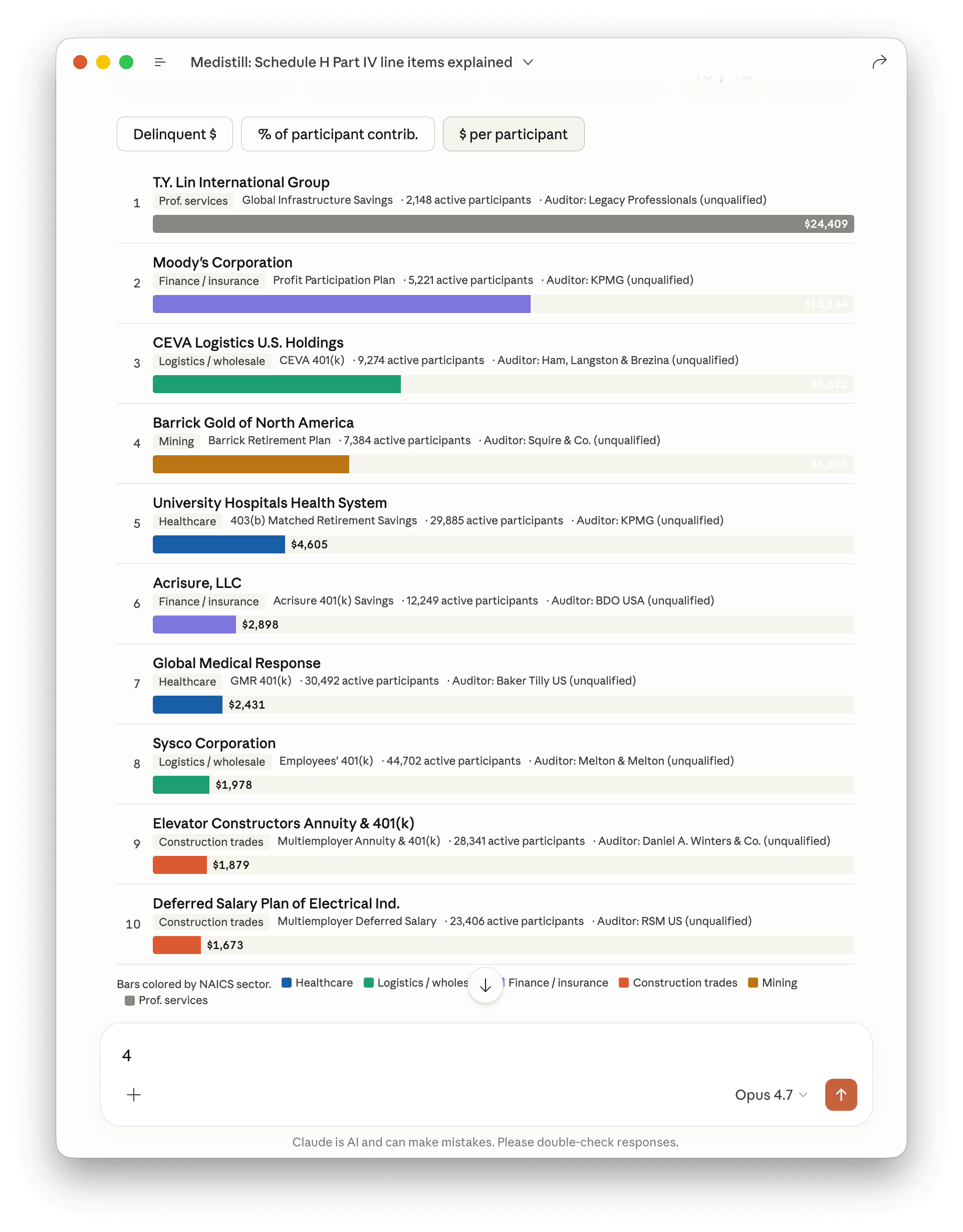
The lens-flip is the analytical content
By raw dollars, University Hospitals is the headline. By percent of participant contributions, CEVA is the headline (237 percent, accumulated). By per-head exposure, T.Y. Lin is the headline ($24,409 per participant, smallest plan in the top 10).
A broker walking into a meeting with CEVA needs a different conversation than a broker walking into a meeting with T.Y. Lin, and both are different from the conversation with University Hospitals. The cohort table on its own does not surface this. Three rotations of the same data do.
The same three lenses generalize to every other Part IV disclosure (party-in-interest transactions, loss-discovered-during-year, fidelity bond inadequacy). Schedule H Part IV becomes diligence content once you rotate the numerators against the right denominators. For the rest of this post we use the raw-dollar view as the anchor, with the caveat that the other two lenses are sitting on the same query when you need them.
The repeat pattern
Prompt 2:
> Show me University Hospitals' late-deposit history across every year on file. Group by plan.
The University Hospitals trajectory tells a cleaner story than any single year. Sixteen years of Schedule H filings on record. Thirteen of them are clean. The Line 4a flag first appears in plan year 2022 and persists on two of the three plans through 2024.
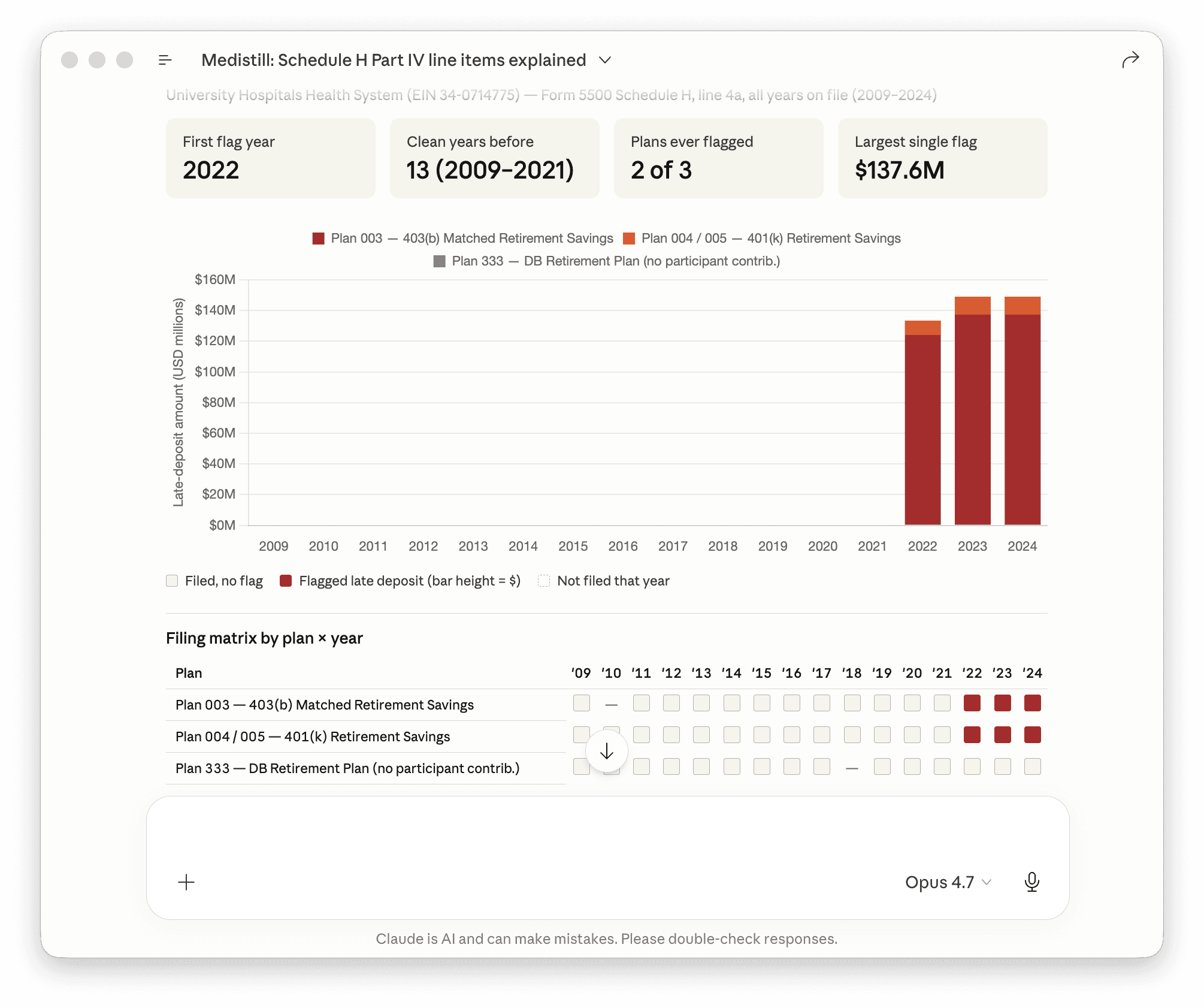
Two structural observations the chart makes obvious. First, the DB plan (Plan 333) is never flagged. That is not luck. Defined-benefit plans hold only employer contributions in trust; participants do not contribute payroll deferrals into a DB plan, so the failure-to-transmit-contributions concept does not apply. Line 4a is structurally inapplicable to Plan 333. The DC plans (003 and 004/005) are the only plans where this disclosure can ever fire.
Second, the year-over-year amounts are the tell:
University Hospitals Health System, Line 4a by plan and year
Plan
2022
2023
2024
403(b) Matched Retirement (Plan 3, $2.46B EOY assets)
$124,041,758
$137,609,142
$137,609,142
DC Plan (Plan 4, $766.9M EOY assets)
$9,404,210
$11,353,640
$11,353,640
Source: DOL Form 5500 Schedule H Part IV, plan years 2022 through 2024, EIN 340714775, plan numbers 3 and 4.
The 2022 to 2023 step-up on both plans means at least one additional late-deposit cohort was disclosed in plan-year 2023. The 2023 to 2024 hold-flat (to the dollar, on both plans) means no incremental late deposits in 2024 and no closeout yet on the prior amount. The amounts re-print on every annual filing until the prohibited transaction clears through VFCP. A flat year-over-year disclosure is the textbook signature of a sponsor in active correction.
The same pattern shows up at Sysco, where the 2024 Line 4a of $88.4M is the largest single-year disclosure on the filing and the company's 2023 figure was a multiple lower. Sysco's pattern is earlier in the cycle: the disclosure spike happened in 2024 rather than 2022. The correction work is presumably underway but not yet visible to outside observers.
The thirteen-clean-then-three-dirty arc is information that exists on the public filings but has never been queryable as a cohort. The same question across every sponsor with a current Line 4a flag would surface which sponsors have a comparable trajectory (clean for a decade then suddenly disclosing), which signals a fresh fiduciary issue rather than a chronic one. Medistill makes that a single query rather than a stack of PDFs.
Who signs off
Prompt 3:
> Among sponsors with material late-deposit disclosures in 2024, which audit firms have the biggest client exposure?
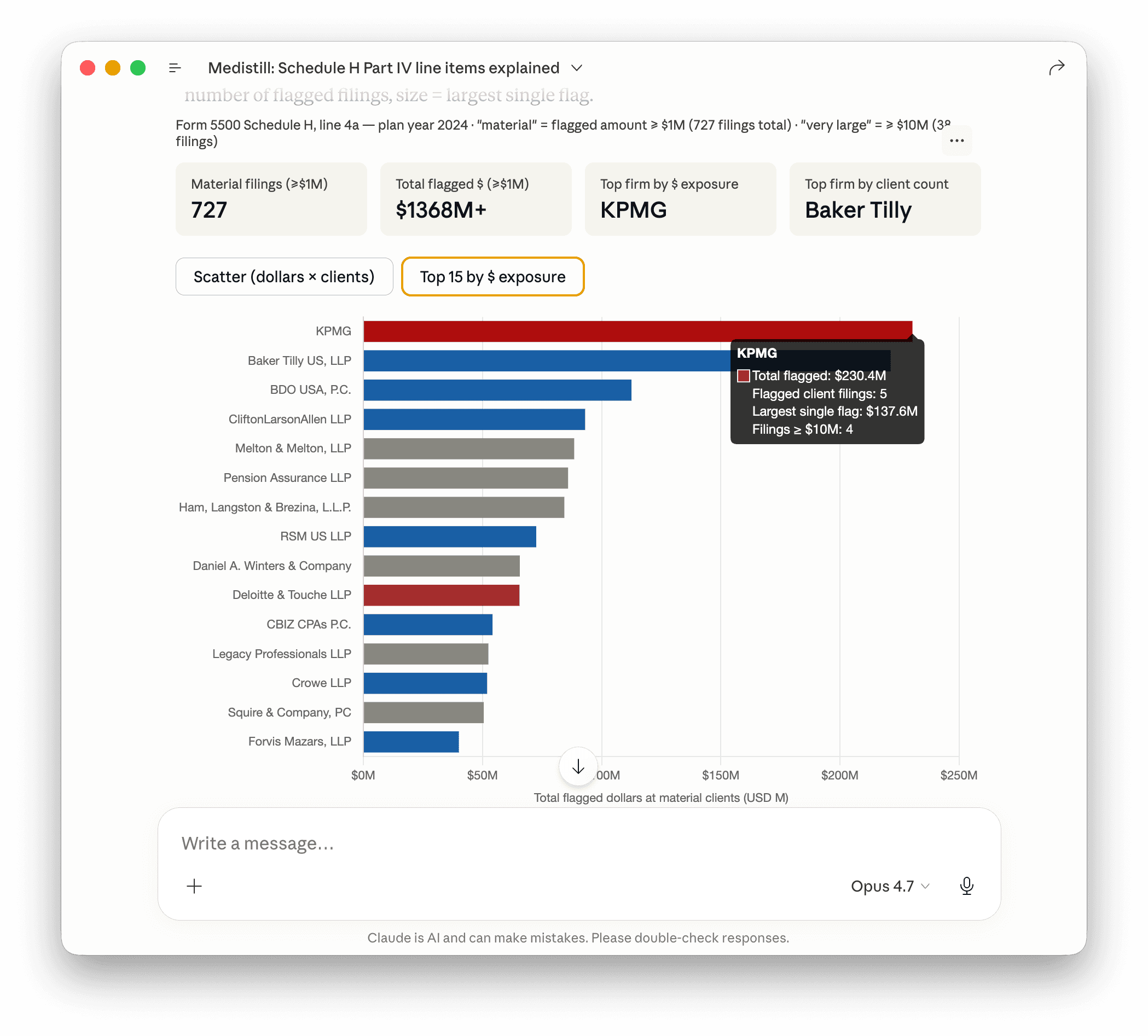
Every Schedule H filing also names the independent qualified public accountant (IQPA) that audited the plan. This field has been on the form since the inception of Form 5500 in its modern shape. It was not previously joinable to the Part IV compliance flags as a cohort query. With the full Schedule H surface now ingested, the agent set its own materiality threshold from the 2024 distribution. Of 15,524 filings with the Line 4a flag, the median amount is $33,616 and the 95th percentile is roughly $941,000. Setting the bar at $1M captures the top five percent of the disclosure universe (727 filings, $1.37 billion in total flagged dollars) and excludes the long tail of small VFCP-style cure amounts. That is the cohort we aggregate by audit firm below.
The same data plotted as a scatter makes the concentration profile visible at a glance:
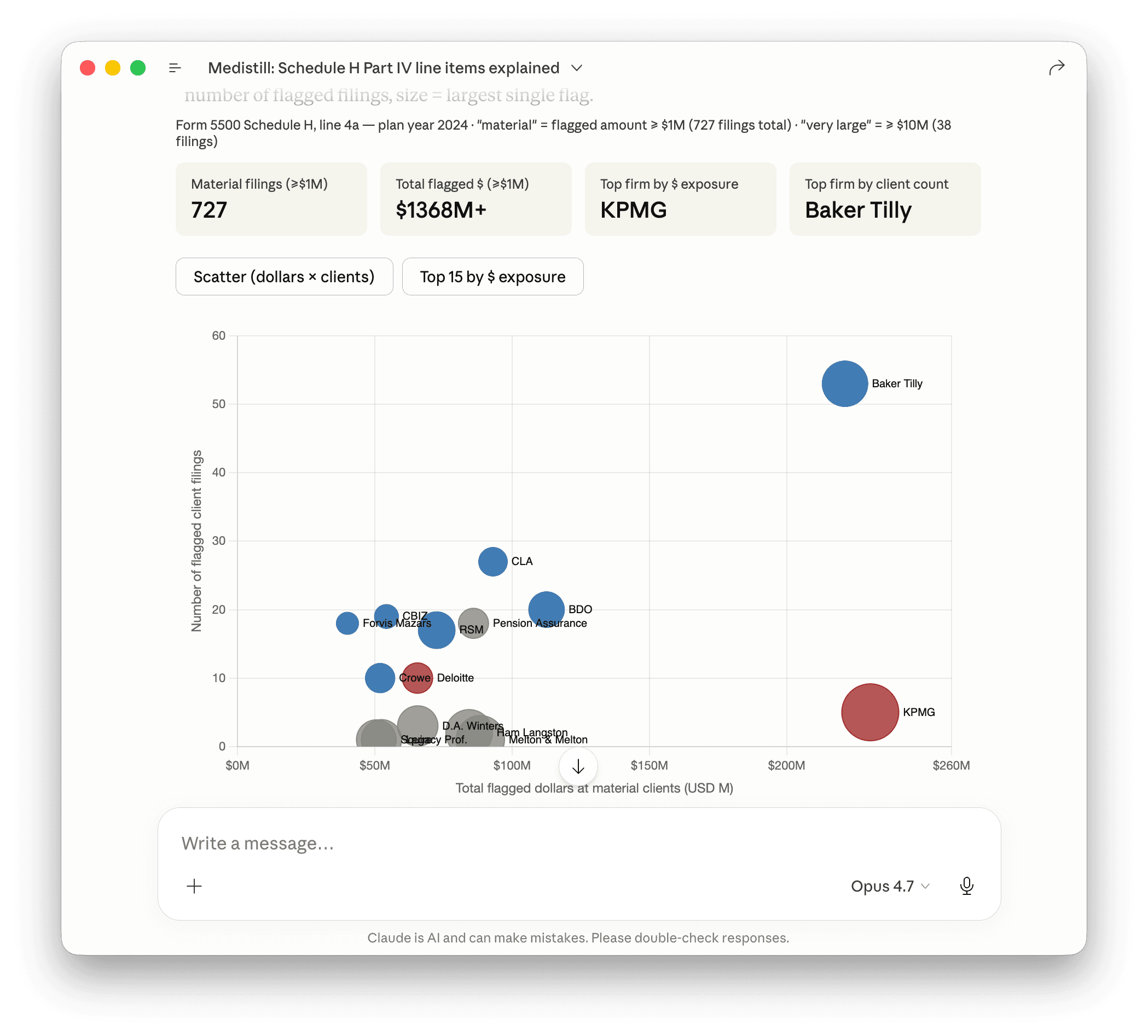
Two different shapes of exposure live in the same ranking. KPMG's $230 million comes from five client filings, anchored by the $137.6 million University Hospitals 403(b) disclosure. That is concentration risk. Baker Tilly's $221 million is spread across fifty-three client filings with no single anchor. That is pattern exposure. Different risk profiles for the firm, different conversation if you are the firm's independence committee or its peer-review file.
The single-client outliers are a third category. Five firms in the top 15 (Melton & Melton, Ham Langston & Brezina, Daniel A. Winters & Co., Legacy Professionals, Squire & Co.) each rank highly off one big client. These are not firm-wide patterns. They are firm-client pair exposures, often a regional CPA that signed the IQPA opinion for one large multiemployer or mid-market sponsor that happens to be carrying a material Line 4a disclosure.
Across all 205 flagged client filings audited by these top-15 firms, only 6 received anything other than an unqualified opinion. Line 4a is a Part IV compliance flag, not an audit qualifier, so an unqualified opinion alongside a material flag is technically correct. The volume of clean opinions alongside material flags is itself the diligence-relevant pattern. A reader asking “is the audit firm doing its job” will answer that question differently when she sees the ratio.
Two of the Big Four make the top 15. KPMG is first on dollars. Deloitte is tenth ($65.5M, 10 client filings, largest $21.2M). PwC and EY do not appear at the $1M threshold. That is itself a diligence-relevant observation: the Big Four ERISA audit practices are concentrated at a small number of very large sponsors, and only KPMG has a current flag at the headline-dollar scale.
None of this says any audit firm caused or missed the underlying late deposits. Line 4a is the sponsor's self-disclosure. The auditor's role is to verify the disclosure was made and tested, not to prevent the underlying delinquency. The cohort view is a structural map of where the disclosures live, not a performance ranking of audit firms.
The bond bump tell
Prompt 4:
> Track University Hospitals' fidelity bond over time.
Schedule H Part IV also requires sponsors to disclose the amount of their ERISA fidelity bond. The bond protects the plan against loss from fraudulent or dishonest acts by people who handle plan funds. ERISA Section 412 sets the required bond at 10 percent of the funds handled, with a $500,000 cap that rises to $1 million if the plan holds employer securities. Most plans bond at the statutory minimum and never revisit the number.
A sudden, large change in the fidelity bond is a signal. It almost always means the sponsor's fiduciary review prompted an internal control upgrade (or a quiet downsize). The full University Hospitals trajectory shows three discrete changes, not just the one bump:
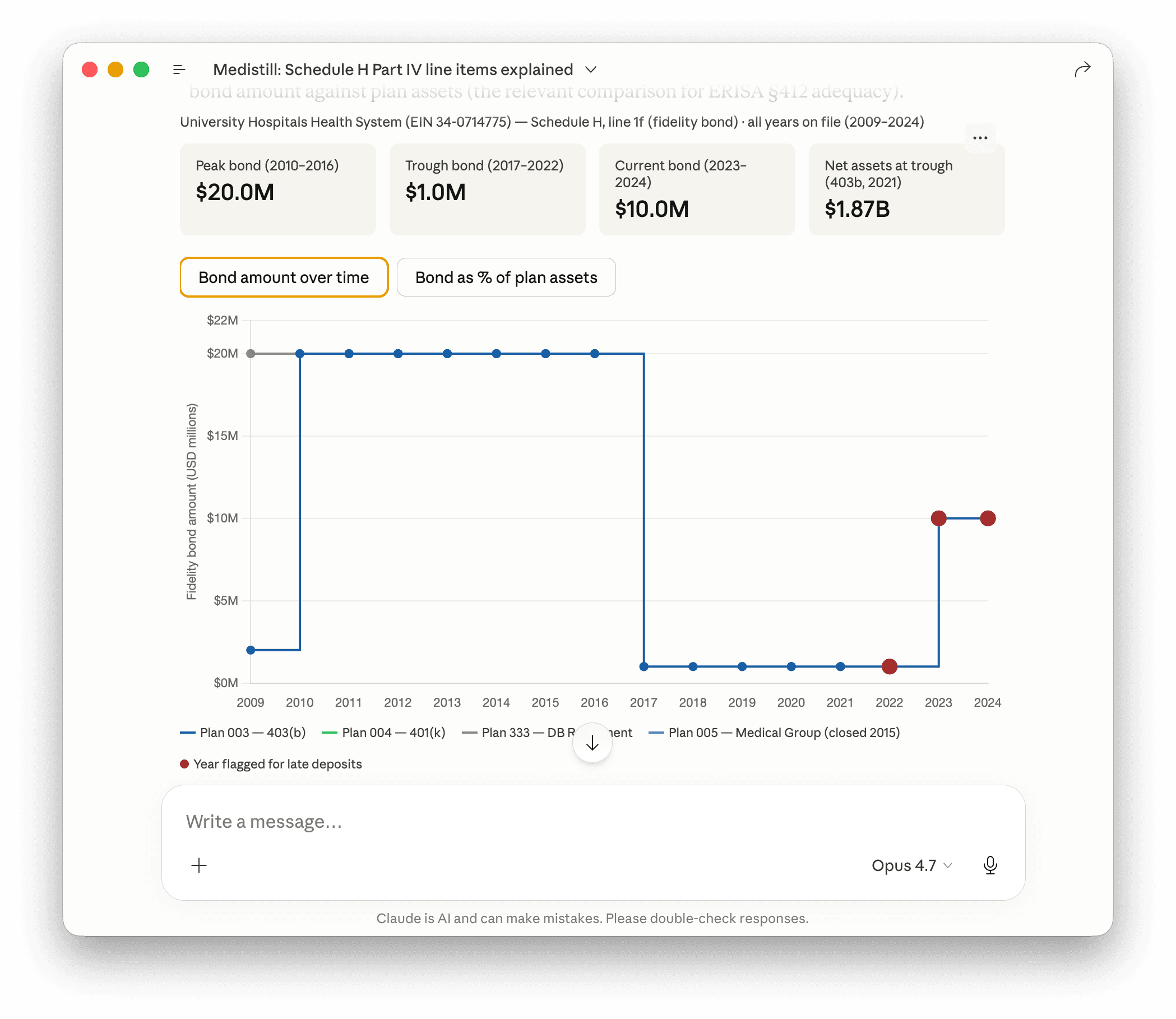
The 2017 step-down is the more interesting move on its own. Coordinated across all three active plans in the same year, the bond dropped from $20M to $1M and held at that level for six consecutive plan years (2017 through 2022). During that same window, combined plan net assets across the three plans grew from approximately $2.59B to $3.94B. The statutory $1M floor was satisfied on its face. The 10-percent-of-funds-handled test is a separate calculation that requires contribution-flow data not visible on the four-corners of Schedule H, but the absolute bond ratio against plan assets is queryable and reveals the structural drift:
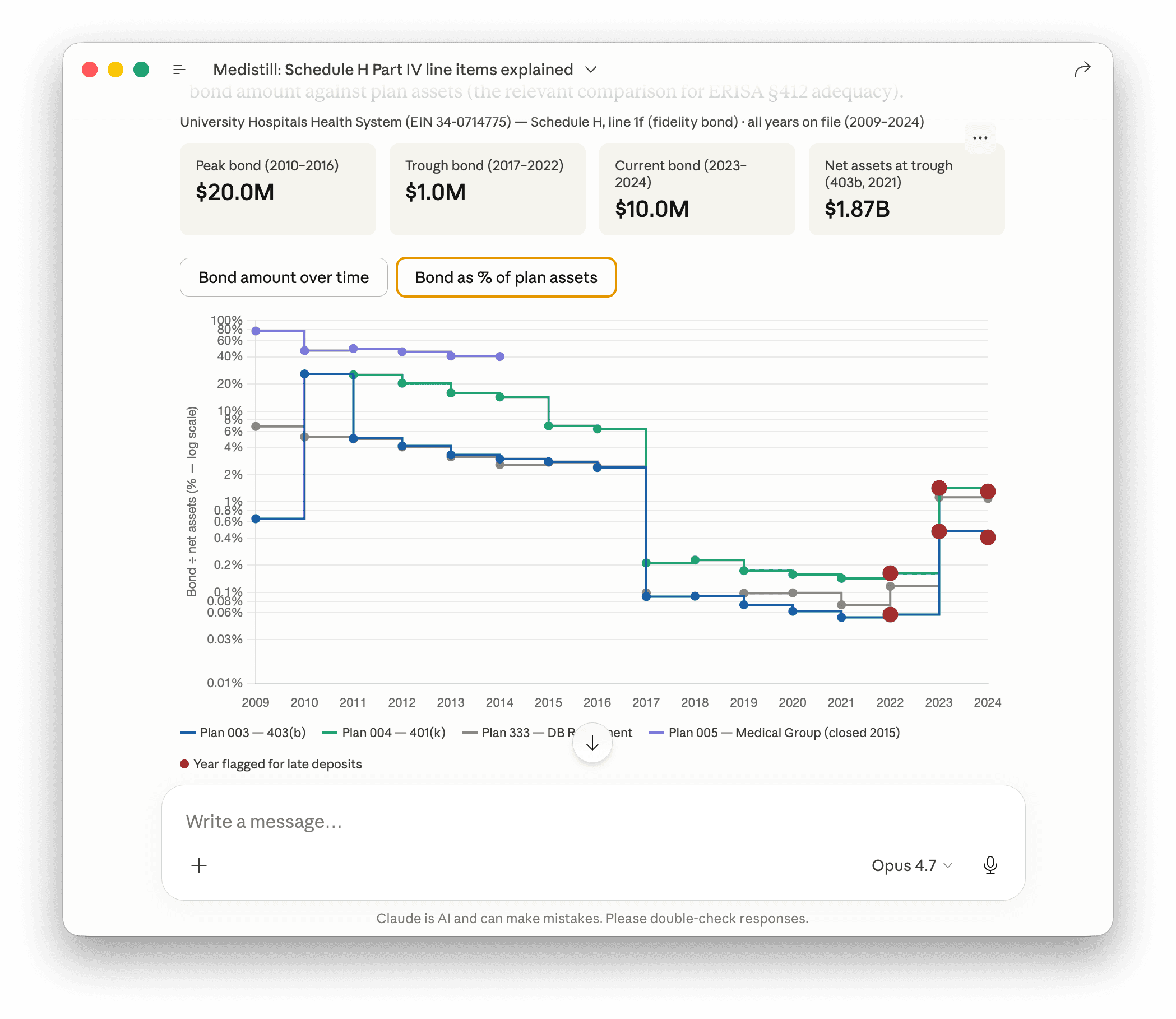
The 2023 step-up from $1M to $10M is the bump that most analysts notice first. It is the wrong place to start. The 2017 trough lasted six years and spanned roughly $1.4B in plan-asset growth without a corresponding bond adjustment. The 2023 step-up raised the bond by 10x on paper but only restored the ratio to roughly 0.4 percent of net assets, which is well below the 2009-to-2016 baseline.
The timing relationship to Line 4a is precise. The flag first appeared in plan year 2022, while bond was at the $1M trough. The bond stepped up to $10M in plan-year 2023. Whether the sequence was triggered by the Line 4a disclosure, by the SECURE 2.0 fidelity-bond environment, or by an independent internal review, the four-corners of the public filing does not say. The pattern is that the bond moved up the year after the flag, which is the standard correction-engagement cadence.
Plan 333 (the defined-benefit pension) carries the same bond profile as the contributory plans (the $20M to $1M to $10M sequence) despite never being flagged on Line 4a. That is expected. The fidelity bond covers fraud and handling risk for all plan funds; it is not specific to participant contributions. The coordinated movement of the bond across all three plans is therefore a sponsor- level decision, not a per-plan response to the Line 4a issue. Whoever made the call in 2017 made it for the whole benefits program.
What it means for three audiences
The Schedule H Line 4a surface is operationally useful to three distinct buyers. Each reads the same data differently:
Benefits brokers and TPAs
The Line 4a disclosure is a meeting-opener. Walking into a renewal conversation with a sponsor whose prior year filing shows a flagged Line 4a, and asking about VFCP status, communicates that the broker has done the homework. Most incumbent brokers have not. The displacement pitch is not on price; it is on the fiduciary support the sponsor was paying for but did not get. The audit-firm cluster overlay (see section 4) makes the prospecting list defensible: pull every CLA-audited or Baker-Tilly-audited plan in your geography with a 2024 Line 4a flag, that is the list.
Private-equity deal teams
Pre-LOI diligence on any healthcare or business-services target should pull the target's Schedule H Part IV automatically. A material Line 4a disclosure, especially one with a year-over-year hold-flat pattern, materially changes the deal model. The cost of full VFCP correction is rarely modeled in benefit-plan diligence at the LOI stage. For the University Hospitals example, the principal alone is $137M and the fully-loaded correction cost runs $150M to $170M. For a $5B-revenue target with a $137M plan-correction overhang, that is a real adjustment to the purchase price or the rep-and-warranty escrow. The Sysco-Moody's-CEVA-GMR receipts are not in the high-profile press; they show up only on the Schedule H.
ERISA fiduciary defense counsel
Client intake screening should include the Line 4a history. A prospect carrying a multi-year Line 4a disclosure, especially one that has held flat year over year, is signaling that the VFCP correction is open and that DOL EBSA may already be in correspondence. Knowing this before the engagement letter is signed avoids both unpleasant surprises and conflicts. Cross-referencing the Line 4a history against the DOL Secretary federal-court docket (already pulled by Medistill on the ERISA fiduciary toolset) tells counsel whether the matter is in pre-litigation correction or has already escalated.
None of the three workflows above is exotic. They are the standard outside-counsel, broker, and deal team workflows that have existed for thirty years. The constraint was always the data: Schedule H Part IV lived on PDFs in EFAST2, queryable in theory and almost never queried in practice. The 2024 cycle closed that constraint. The receipts are visible.
What was the analyst-week question two years ago is the thirty-second query today. The competitive advantage shifts from data access to question design.
Closing
There is no scandal in this post. Every sponsor named here filed the disclosure on time, in the correct field, on the correct line. The disclosures are working as designed. The cumulative re-print pattern is the regulator's deliberate signaling that the prohibited transaction is still open. Sponsors in active VFCP correction are doing exactly what the Department of Labor wants them to do.
The point of the exercise is that disclosures designed for one audience (the regulator) carry actionable information for three other audiences (brokers, deal teams, fiduciary defense counsel) that have historically lacked the tooling to read them at cohort scale. The receipts have been there. The cohort query has not.
The 2024 cycle is the cleanest demonstration we have. Five sponsors, $448 million in combined disclosed Line 4a, fifteen audit firms holding the majority of the material-violator book, one integrated-delivery network ($137 million, three consecutive years, three discrete fidelity-bond moves on the same plan history) telling the entire correction story on a single set of public filings.
The next 2025 Schedule H releases will publish starting October 2026. The Sysco closeout, the University Hospitals next-step disclosure, and the GMR correction status will all show up in the data by spring 2027. The query that ran in thirty seconds today will run again, on the next year's file, in thirty seconds.
Run the queries yourself
Every prompt in this post runs in Claude with the Medistill connector. Pull any sponsor's Schedule H Part IV history, audit firm continuity, and Line 4a disclosure profile in a single query. Free for seven days, full access.
from $199/month, Cancel anytime. Full Form 5500 family coverage including Schedule H Part IV, Schedule A, Schedule C, and DOL Secretary federal-court enforcement history.